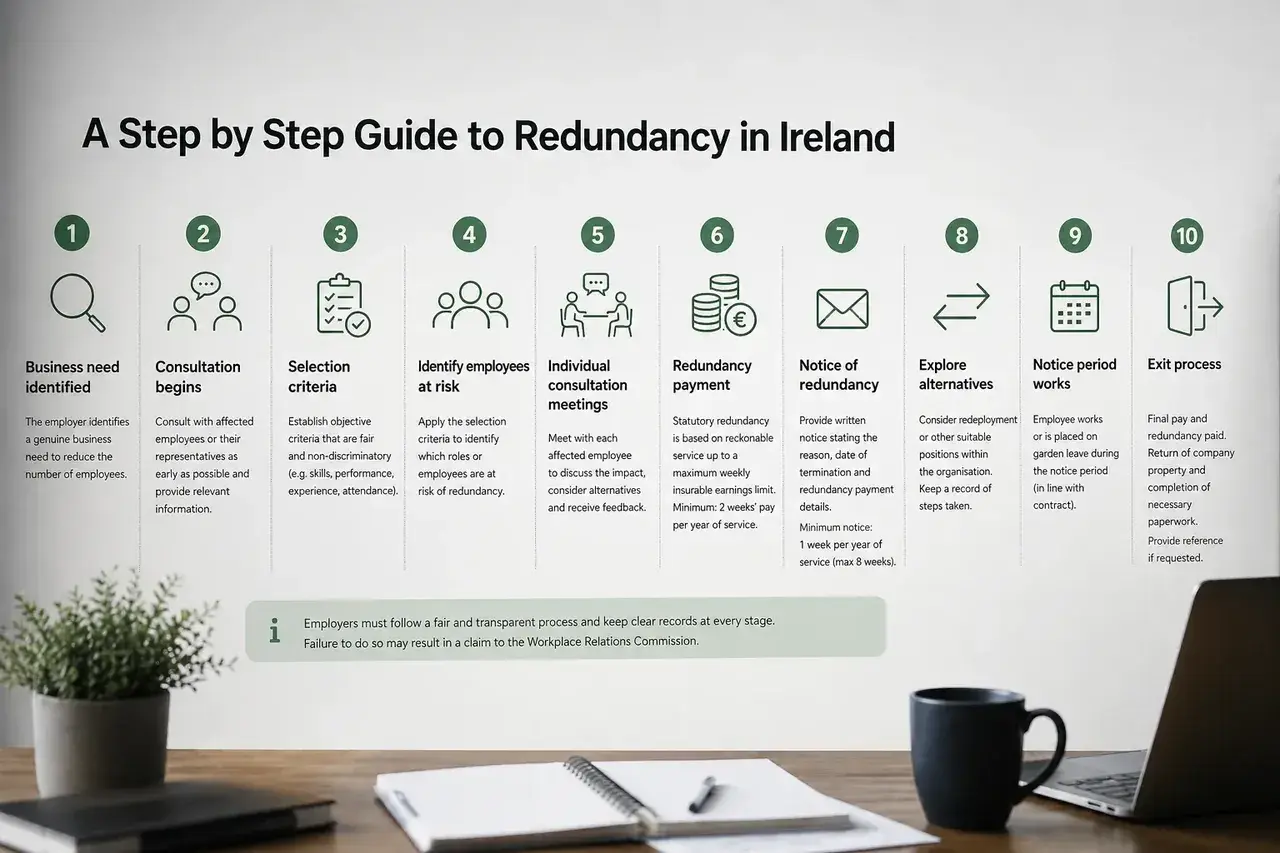


Statutory redundancy in Ireland sounds simple enough: two weeks’ pay per year of service, plus a bonus week, paid to any qualifying employee whose role is genuinely eliminated. But the word qualifying is doing a lot of heavy lifting in that sentence. A recent Irish Times report about a political adviser whose redundancy entitlement was disputed after a move to the European Parliament shows just how complicated qualifying service can become in non-standard employment arrangements.
The case involved an adviser whose Leinster House role was made redundant in 2024 when the politician they worked for was elected to a parliament outside Ireland. The adviser was told a statutory redundancy payment would only become available if the politician lost their seat. The details are unusual, but the underlying problem is one our team at PurpleTree HR encounters regularly: employers and employees alike assuming redundancy entitlement is automatic, when in fact it depends on a set of qualifying conditions that are easier to fail than most people realise.
Statutory Redundancy Ireland: The Quick Answer
To qualify for a statutory redundancy payment under the Redundancy Payments Acts 1967-2014, an employee must have at least 104 weeks (two years) of continuous service, be aged 16 or over, and be in insurable employment under the Social Welfare Acts. The payment is calculated at two weeks’ gross pay per year of service, plus one bonus week, subject to a weekly earnings cap of €600. If any of those qualifying conditions are not met, the entitlement does not arise, and the employer who assumes otherwise may face either an unexpected bill or a WRC complaint.
Why Qualifying Service Trips Employers Up
Most employers understand that a redundancy payment exists. Fewer understand the specific conditions that must be satisfied before the obligation kicks in. The 104-week continuous service requirement is the one that causes the most problems, particularly in sectors where employment arrangements are anything but straightforward. Getting that assessment right before notifying anyone is where employer redundancy support in Ireland makes the difference between a clean process and a WRC claim.
Consider the types of roles where continuous service is easily disrupted or disputed: fixed-term contracts that roll over with gaps between renewals, seasonal work in hospitality or retail, project-based engagements in construction, and politically appointed positions tied to an officeholder’s term. In each of these situations, whether 104 weeks of continuous service actually exists is a question that requires careful analysis of employment records, contract terms, and the specific circumstances of any breaks in service.
A situation we see frequently involves employers who have re-hired the same person multiple times on successive fixed-term contracts. Each contract might be only 10 or 11 months long, with a short gap in between. The employer assumes no redundancy entitlement arises because no single contract exceeds two years. But the WRC may take a different view if the gaps are short enough, or if the work was effectively continuous despite the contractual breaks. The outcome depends on the facts, and the employer who has not documented those facts properly is at a significant disadvantage.
Non-Standard Arrangements and Statutory Redundancy Exposure
The political adviser story is a sharp illustration of how non-standard employment arrangements create redundancy headaches. The role was tied to a specific politician. When that politician’s circumstances changed, the role was eliminated. But the question of whether the adviser had a continuous employment relationship, and with whom, turned into a dispute.
Irish employers outside of politics face similar challenges more often than they might expect. In our experience advising employers across Ireland, the following arrangements regularly cause confusion around statutory redundancy entitlement:
- Fixed-term contracts with renewal gaps. Short breaks between contracts do not always reset the service clock. The WRC will look at the substance of the arrangement, not just the paperwork.
- Seasonal and cyclical work. Employees who return each season to the same employer may accumulate continuous service across multiple cycles, even if they were technically “let go” each time.
- Transfers between related entities. Where an employee moves between companies in a group, the question of whether service transfers can determine whether a redundancy entitlement exists at all.
- Agency and subcontractor arrangements. Misclassifying an employee as a contractor does not eliminate redundancy exposure. If the WRC determines an employment relationship existed, the service clock may have been running all along. Our guide to contractor redundancy rights in Ireland covers where the contractor label falls apart.
Each of these scenarios involves overlapping questions of employment status, continuous service, and contractual documentation. Getting any one of them wrong can mean either paying a redundancy lump sum you did not budget for, or failing to pay one you owed and ending up at the WRC. The sections below work through the eligibility edge cases that most often produce disputes.
Outsourcing, Contractors and Redundancy Obligations
Engaging people through an agency, a contracting company, or a rolling contractor arrangement does not move your redundancy exposure off your books. If the WRC concludes that someone labelled a contractor is, in substance, an employee, the qualifying-service clock has been running all along, and a statutory redundancy entitlement can crystallise when the arrangement ends. The test is the reality of the working relationship rather than the wording of the contract: who controls the work, who carries the financial risk, whether a substitute can be sent, and how integrated the person is into your operation. Our guide to where the contractor label falls apart sets out how the WRC and Revenue weigh those factors.
Declining to engage with the process does not make it disappear either. The WRC can hear a complaint and issue a decision in an employer's absence, on the claimant's evidence alone, which usually produces a worse result than turning up would have. For an employer with a handful of long-standing contractors who function as employees, the exposure is not one claim but potentially one for each worker, so the time to test the structure is before the relationship ends, not after a complaint lands.
Continuous Service: What Breaks It and What Does Not
The concept of continuous service under the Redundancy Payments Acts is not as intuitive as it sounds. Certain absences do not break continuity: periods of sick leave, annual leave, maternity leave, or lay-off, for example, generally preserve the service record. Other absences, such as a genuine resignation followed by a new start, typically do reset the clock.
The grey areas are where employers get into trouble. A two-week gap between fixed-term contracts might look like a clean break on paper, but the WRC will consider whether the employee was expected to return, whether the role continued to exist, and whether the employer’s intent was to avoid building up qualifying service. Employers who structure contracts to sidestep the 104-week threshold are taking a risk that a WRC adjudicator will see through the arrangement.
This is one of the areas where having specialist HR support makes the difference. Assessing whether a particular employment history constitutes continuous service requires a detailed review of contracts, payroll records, correspondence, and the practical reality of the working relationship. Our employment contracts service includes exactly this type of review, ensuring contracts reflect the actual arrangement and that employers understand their exposure before a redundancy situation arises.
Once Entitlement Crystallises, Payment Cannot Be Deferred
The political adviser case turns on exactly this point. Once a genuine redundancy has occurred and the qualifying conditions are met, the statutory entitlement crystallises at the date employment ends. An employer cannot defer payment pending a future event, make it conditional on the employee signing a waiver, or use it as a bargaining chip in settlement negotiations.
Failure to pay on time entitles the employee to pursue the debt through the WRC or the civil courts. The most common version of this problem in the private sector involves employers under cash flow pressure who delay payment. That delay does not suspend the legal obligation, and financial difficulty is not a defence. An insolvent employer can apply to the Department of Social Protection’s Redundancy Payments Scheme to have payments advanced by the State, but that route does not eliminate the underlying liability.
Suitable Alternative Employment and the Four-Week Trial Period
An employee who unreasonably refuses an offer of suitable alternative employment loses their redundancy entitlement, but the word “suitable” carries significant weight. The WRC assesses suitability objectively, by reference to the nature of the work, pay, location, hours, and overall terms compared with the redundant position. A role on lower pay, materially different hours, or at a location that creates genuine practical difficulty will rarely satisfy the test, regardless of what the employer considered reasonable.
Where an alternative role is offered, the employee is also entitled to try it for up to four weeks under the Redundancy Payments Act 1967, or longer where an extension for retraining is agreed in writing. Working the trial does not amount to accepting the role, and an employee who rejects it during the trial keeps their claim to the statutory payment unless the offer was suitable and the refusal unreasonable. Treating a trial-period rejection as a resignation is incorrect and opens the employer to a WRC claim.
Collective Redundancies: When Additional Obligations Apply
Redundancy obligations also scale with numbers. Where an employer proposes a defined number of redundancies within a 30-day period, the Protection of Employment Act 1977 imposes collective redundancy obligations. The thresholds are:
- At least 5 redundancies where the employer has 21 to 49 employees
- At least 10 where 50 to 99 employees
- At least 10% where 100 to 299 employees
- At least 30 where 300 or more employees
Where the thresholds are met, the employer must notify the Minister for Enterprise, Trade and Employment at least 30 days before the first redundancy takes effect, consult with employee representatives, and provide specified information in writing. Failure to comply is a criminal offence. Project-end redundancies in manufacturing and construction can trigger collective obligations faster than anticipated, and for larger-scale restructuring our strategic HR consulting service manages the collective process end to end.
Two High-Risk Traps: Protected Leave and Selection
Redundancy During Maternity or Other Protected Leave
Redundancy during maternity leave is one of the highest-risk scenarios in Irish employment law. Under the Maternity Protection Act 1994, a notice of termination served while an employee is on maternity leave is void, and the employee has the right to return to their role, or a suitable alternative on no less favourable terms. Any dismissal connected with pregnancy is automatically unfair, with no service requirement attached to the claim. If a genuine restructuring affects an employee on protected leave, the employer must be able to demonstrate that the leave played no part in the selection, and the timing and documentation need particular care.
Selection From a Pool Must Be Impersonal
Redundancy attaches to the role, not the person. Where a redundancy involves selecting from a pool, the criteria must be objective, applied consistently, and related to business requirements. Selection based on attendance records that include protected absences, such as disability-related sick leave or maternity leave, can expose the employer to discrimination claims. And where the selection appears tailored to remove a particular individual, the WRC will examine whether it is genuinely a redundancy or a performance dismissal dressed up as restructuring. Our guide to the WRC’s genuine redundancy test covers how adjudicators look through the label.
Rushing a Redundancy Is an Unfair-Dismissal Risk
The mirror image of a disputed qualifying-service claim is the employer who tries to defeat it by moving early. Where a group of employees are all approaching the 104-week mark, the temptation is to terminate before the threshold triggers an entitlement. It rarely works. If the WRC decides a dismissal was not a genuine redundancy but was timed to avoid a statutory payment, it is treated as an unfair dismissal instead, and compensation for unfair dismissal can run to as much as two years' remuneration under the Unfair Dismissals Acts 1977-2015. That is far more than the redundancy sum the timing was meant to save.
Reported allegations in 2026 that a large Dublin contractor accelerated lay-offs to keep staff below the two-year threshold put the tactic in the news, but the pattern turns up well beyond the headlines. A single termination near an anniversary raises no flags. A cluster of dismissals falling days short of the 104-week mark is exactly what a WRC adjudicator scrutinises, and thin consultation or a weak paper trail is what turns a defensible business decision into a claim.
The Financial and Legal Risk of Getting It Wrong
Failing to pay a statutory redundancy entitlement is not a minor administrative oversight. An employee who believes they are owed a redundancy payment can refer a complaint to the Workplace Relations Commission. If the WRC finds in their favour, the employer will be ordered to pay the full statutory amount. In some cases, additional compensation may be awarded if the WRC considers that the employer acted unreasonably or in bad faith.
For a long-serving employee earning at or above the €600 weekly cap, the statutory redundancy payment alone can run into tens of thousands of euro. Add in the cost of legal representation, management time spent preparing for a WRC hearing, and the reputational risk of a published adjudication, and the total cost of getting qualifying service wrong becomes substantial.
On the other side of the coin, employers who pay redundancy when it is not owed, because they assumed the entitlement existed without checking, are spending money they did not need to spend. Both errors stem from the same root cause: not properly assessing qualifying service before the redundancy takes effect.
How PurpleTree Handles Redundancy for Irish Employers
When we guide clients through a redundancy at PurpleTree, the qualifying service assessment is one of the first steps. Before any conversations with affected employees, before any letters are drafted, we review the employment history in detail: contracts, payroll records, any gaps or breaks, and the nature of the working arrangement.
This is where the complexity sits. A redundancy that looks straightforward on the surface can involve questions about continuous service, PRSI insurability, transfer of undertakings, and whether fixed-term contract renewals have created an unintended permanent employment relationship. These are not questions most employers are equipped to answer confidently on their own, and a wrong answer carries real financial consequences.
Our redundancy and dismissals service covers the full process, from initial assessment of entitlements through to consultation, documentation, and WRC compliance. Once qualifying service is confirmed, the remaining steps follow the sequence set out in our redundancy process guide for Irish employers. For employers who want to ensure their broader HR framework is sound before any redundancy arises, our HR audit identifies gaps in contracts, records, and policies that could create exposure down the line.
The goal is straightforward: employers should know exactly where they stand before a redundancy conversation begins, not after a WRC complaint arrives. If you are planning a redundancy or restructuring, or if you have employees on non-standard arrangements and are unsure about your exposure, get in touch with our team before the situation becomes urgent.
This article is for general informational purposes only and does not constitute legal advice. Employment law is complex and fact-specific. For advice on your specific situation, contact the PurpleTree HR team directly.
Statutory redundancy questions answered
On this page